Creating more drought-resilient farms through pioneering project
Creating more drought-resilient farms through pioneering project
A major research effort is linking how innovative farming practices and historical long-term trial results can combine to boost the drought resilience of cotton and grain farms.
The Long-Term Drought Resilient Practices for Climate-Smart Cropping Systems project aims to unite researchers, growers and industry to deliver practical, evidence-based solutions to help farmers prepare for, manage and recover from drought.
One of the cotton industry’s leading researchers, NSW DPIRD Soil Scientist Dr Guna Nachimuthu, is leading the five-year project through funding under the Australian Government’s Future Drought Fund (FDF) with support from NSW DPIRD, CRDC and partners. The project will focus on cotton systems while delivering broader benefits to grains and pulses across northern Australia.
The project will not only investigate but demonstrate how using integrated management strategies and technology can mitigate drought-related yield loss and improve water use efficiency through a network of 25 trial sites in NSW, Qld and the NT. Long-term cropping trials will be expanded in NSW and established in southern Qld.
NSW DPIRD Manager Sustainable Soils Dr Belinda Hackney said this investment builds on the learnings of past projects and deliberately includes a large number of on-farm trial sites from the start to ensure there’s a robust mechanism for delivering findings and ensuring feedback between researchers and growers.
“The novelty of this project lies in its approach – integrating knowledge and tools from a wide range of disciplines, research and grower organisations,” Belinda said.
“The network of on-farm trials will help ensure collaboration between the researchers, the extension team and growers to accelerate the adoption of drought-resilient farming practices.”
Taking a multi-disciplinary and farming systems approach has created a broad range of research and development (R&D) opportunities which include improved irrigation decision support frameworks to guide farmers before, during and after drought, and taking a closer look at key climate drivers affecting the northern Murray-Darling Basin.
In collaboration with cotton growers and the project partners, the project will test and trial:
Drought-resilient crop rotation systems to conserve moisture in semi-irrigated systems, and how these impact soil water and carbon storage, crop production and disease.
Next-generation soil amendments aimed at enhancing soil water storage, soil carbon, improving root access to stored soil resources (water, nutrients) and reducing fertiliser use.
The effectiveness of novel plant growth regulator foliar sprays in reducing transpiration and their impact on root growth.
Drought-resilient farming practices using advanced monitoring technologies, including crop sensors, soil moisture probes and remote sensing.
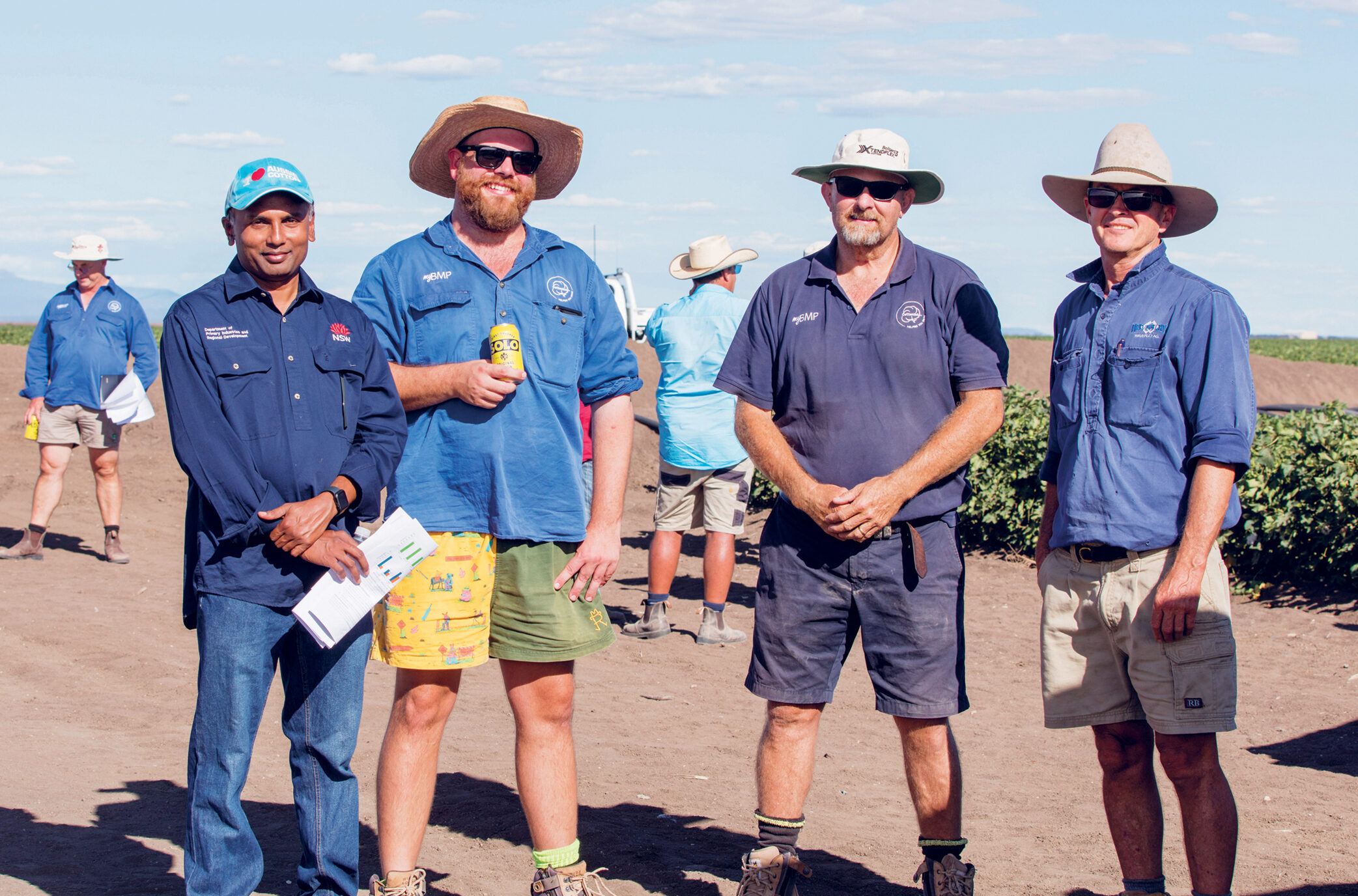
The Long-Term Drought Resilient Practices for Climate-Smart Cropping Systems project aims to unite researchers, growers and industry. Guna (left) is working closely with CottonInfo Regional Extension Officers which includes the Namoi Valley’s Blake Palmer and Bob Ford, pictured with grower Andrew Greste. Blake is also undertaking his PhD study under the project.
Setting up trial sites begins
The project team and partners, including CottonInfo who are playing an important support role, are now working to enlist interested growers and consultants to become part of the new network of 25 trial sites in NSW, Qld and the NT. Becoming a trial site is an opportunity for growers to work with researchers to develop programs that apply the R&D to address their requests. Growers will have the opportunity to see first-hand how the latest real-time crop canopy and soil moisture sensors, combined with remote and satellite imagery can create meaningful crop and soil datasets. This technology will support improved monitoring and management of crop stress, growth and reproductive development and soil water status.
“On-farm experiments work best when they’re a genuine partnership between growers, consultants and researchers,” Guna says.
“In our project, the researchers support the experiment design and data analysis and the farmers take the lead on choosing treatment variables, so the work stays directly relevant to their on-farm decisions – with the added support of CottonInfo Regional Extension Officers and Technical Leads.”
CottonInfo plays a key role
CottonInfo is providing on-farm experimentation support and extension, while research project partners include the University of New England, Western Sydney University, Southern Cross University, University of Southern Queensland, University of NSW, CSIRO and Ag Econ. The Dryland Cotton Research Association, NFC Farming Trust, Goanna Ag, Mungindi Cropping Group and Cotton Grower Associations are also key to the project.
CottonInfo Program Manager Janelle Montgomery said CottonInfo’s main focus is helping develop and provide ongoing support to the on-farm trials.
“Through CottonInfo’s network of Regional Extension Officers, we can replicate trials across cotton regions in line with local conditions,” Janelle said.
“Working with growers and consultants to develop the trial program and collect data will ensure research outcomes can be tested, demonstrated and translated into practical, regionally relevant insights growers can use to improve drought resilience, regardless of where they farm.”
CRDC’s Acting General Manager, Innovation, Susan Maas said most importantly, the project represents a unique opportunity for growers to be a part of the R&D process and then harness the benefits in the long term.
“In a first for growers in Australia’s limited-water cropping systems, an irrigation decision-support framework will be developed that integrates data from the impact of next-generation soil amendments, tactical crop rotations and plant hormone sprays,” Susan said.
“For dryland growers, improved forecasting of crop water requirements will support informed decision-making around drought mitigation options, including crop termination and using growth regulators.
“And, economic analyses of individual and combined farming practices will offer a guide of options for increasing revenue per unit of water before, during and after drought.”
This article appears courtesy of the Cotton Research and Development Corporation (CRDC). It was published in the Winter 2026 edition of CRDC’s Spotlight magazine: www.crdc.com.au/spotlight
Making the most of long-term knowledge
Guna oversaw the development of this project, which uses insights gained from historical long-term cotton trials that identified farming practices that could strengthen climate resilience.
“I wanted to expand on what I’ve learned about cropping systems’ resilience under extreme climatic conditions,” he said.
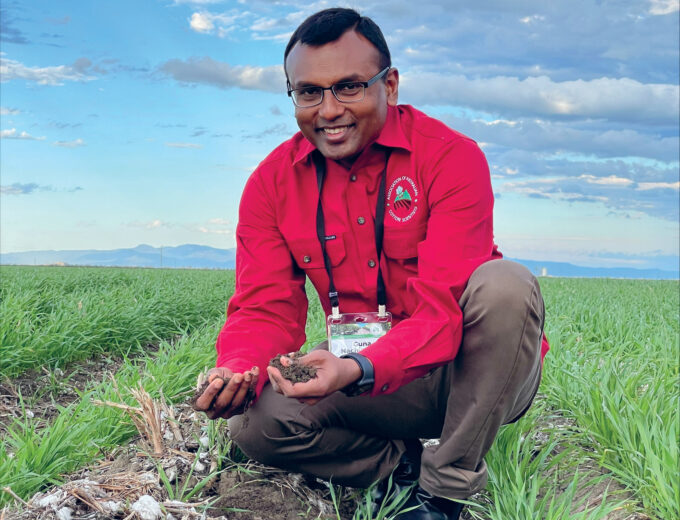
In 2019, one of Guna’s long-term field experiments into maximum and minimum tillage at the ACRI was laser-levelled. Beds were then reformed and a wheat crop established across the treatments. It turned out to be a tough season.
“Despite extreme drought conditions that season, the wheat crop under minimum till showed strong resilience,” Guna said.
“This was significant given the trials had been deep-tilled earlier that year, suggesting the long-term benefits of minimum till can flow into the subsoil and remain even after considerable disturbance.”
As the saying goes: ‘it takes a flood to break a drought’ and in 2021 and 2022, the Namoi Valley experienced widespread flooding. The fields at ACRI were flooded, and the scientists made another observation. The minimum till system maintained bed structure and supported healthy seedling recovery. In contrast, the maximum till suffered bed collapse and poor crop recovery.
“Soil processes underpin this resilience and because these processes are characterised by variability across seasons and regions, it reinforces the importance of a long-term and widespread approach to trials,” Guna said.
“We are focused on improving understanding of seasonal variability and the ‘best bet’ crop management preparation and response to optimise crop outcomes.”