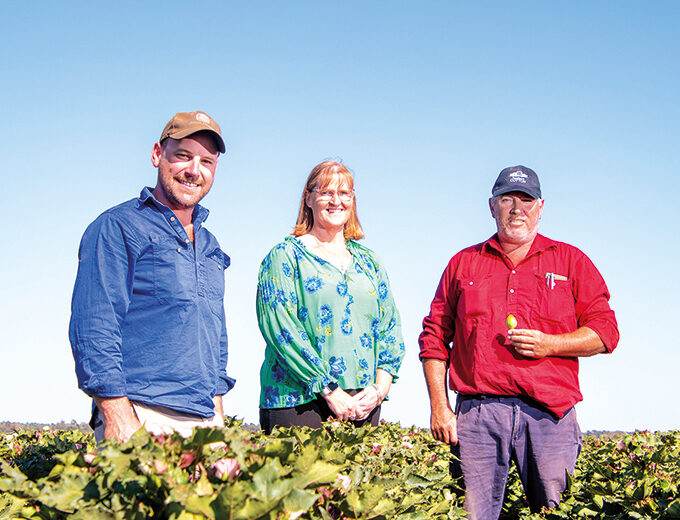
A CRDC Grassroots Grants project on a community-run farm at Coleambally (Wiradjuri country) is helping to overcome the challenges of soil variability and underlying soil constraints – two of the biggest challenges in irrigated cotton in southern NSW.
The positive outcomes of this ongoing project highlight the benefits of small communities working together for the common good, and the role that cotton industry support can play in their sustainable future.
The 400 hectare Murrumbidgee Shire Community Demonstration Farm at Coleambally is run almost entirely by local volunteers and farmers, many with the local APEX club and other community groups.
Each year the Demonstration Farm committee selects six local groups or organisations to grow a crop of their choice and for the past five years, clubs have chosen to grow cotton during summer. The committee retains overhead costs, which are kept low thanks to farmers volunteering their time, and local businesses’ generosity.
While Coleambally was a purpose-built town to service the Coleambally Irrigation District, when it opened in 1968 (see previous story) it lacked many basic community facilities. The community has banded together to build the town, and the Demonstration Farm has made a large contribution to the community’s ability to build and upgrade sporting facilities, schools, local health services and community clubs.
The first community crop was grown in 1996 when the local Lions Club grew a small rice crop. Since then, it’s progressed into a large-scale, volunteer farming operation that grows several crops and has contributed more than $3 million back into the Coleambally community. Just last season, local clubs and organisations benefited from about $300,000, mainly from cotton crops.
The CRDC-supported Grassroots Grant project was initially created under the banner of the Southern Valleys Cotton Growers Association (SVCGA) to improve the soil health of the farm to maintain its value to the community, while also offering valuable extension opportunities.
The project has been developed and managed by local consultant James Kanaley, who saw an opportunity for the funding to assist with identifying local constraints and conveying the knowledge and outcomes to local growers. It’s already having an impact on soil health in the region. The Grassroots Grant helped the participants to start undertaking soil testing and planning for soil amelioration.
“We believe these improvements will make a huge difference to the Demonstration Farm’s soil health and ensure the community farm can continue to operate in the Coleambally community in the future,” SVCGA President Joe Briggs said.
“This project at the Demonstration Farm is having impacts directly on the soil in those fields, but is not confined to them, with benefits being seen through adoption of practices by other growers. So it has been and continues to be a very worthwhile project all round.”
Soil variability is a major issue for farmers around Coleambally. Farmers say within fields there is a mix of natural variability coupled with the effects of intensive rice growing over the years, along with creating larger fields from smaller fields with varied use histories.
“With our variable soils in the region, standard practices in soil sampling and amelioration have been somewhat effective in the past to combat these issues, but we are still seeing soil constraints impact production,” James says.
“With increasing costs of production and water input costs and availability becoming more variable, increasing the profitability of the soils we are dealing with is crucial to the long-term sustainability of crop production in southern NSW.”
James has been the driving force behind this project. He’s given his time and expertise to oversee the project on behalf of the CGA, after witnessing serious soil issues heavily impact productivity for clients on their own farms, and at the Demonstration Farm.
“Due to its history of use and crop rotation, the Demonstration Farm is a challenging one for crop production: soil variability within one field can be quite stark and change aggressively over short distances,” James says.
“This farm basically highlights some of the underlying issues we are seeing commercially across the district.
“We have variability that you won’t find in a lot of other growing regions, and traditional soil sampling methods may not pick up on these constraints.”
The 2022-23 season saw cotton planted into 50 per cent of the study area and irrigated bread wheat in the remaining area. There are eight fields at the Demonstration Farm, with the three main fields fallowed for the 2022-23 summer crop season. All three fields were coming out of a cereal rotation which was planted directly behind cotton from the 2020-21 summer season.
“The fields showed significant variability during the cotton rotation and in one field in particular it was very difficult to establish cotton, with suspect acidity killing off cotton seedlings,” James said.
“To get some more accurate data and assess the soil variability, intensive grid soil sampling was undertaken.
“While there are many soil properties we can measure, we consider sodicity, acidity and phosphorus availability to be the key properties and low hanging fruit we can manipulate.”
EM surveys were also conducted over the three fields to help refine analysing soil variability. They also help to differentiate soil texture changes (sand/silt/clays), locate and install moisture probe sites, define soil testing strategies and analyse yield data.
“While the end goal was sustainability and financial profitability for the farm to be donated into local charities and groups, the learning experience along the way has been of great value to the local farming community,” James said.
“Relaying what we have found to growers that there are potential cost savings with inputs and advancing adoption are key objectives for us.
“Through facilitating the project, local volunteers, farmers and other community stakeholders have increased their understanding and knowledge of soil mapping and nutrition.
“The extension uptake has been very rapid and there has been a dramatic increase in intensive and strategic soil sampling in the area.”
For local grower and APEX member Chris Gardiner, what’s he learned through the project has seen him take another look at soil sampling.
“The product saved from application in the right areas of the fields through variable rate technology convinced me that the grid sampling was worthwhile,” Chris said.
“Prior to this I certainly wasn’t sold on the grid soil sampling that’s for sure, but now I’m excited to see our results and bring our fields more into line.
“It was unfortunate due to wet weather we didn’t get a cotton crop into the main field (field 5) as it had the biggest issues from the soil tests.”
James says the primary environmental benefit is improving efficiency in the use of the farm’s most valuable resource, water.
“More crop per drop and maximising the water holding capacity of the soils also have flow on benefits such as improved nitrogen use efficiency,” he said.
“The project has improved the local environment through incorporating sustainable farming measures and placing a strong emphasis on improving our local environment to achieve the best result for the community, the environment and beyond.
“The soils we are dealing with in the Murrumbidgee and Murray valleys are known to be extremely variable, yet quantifying that variability and communicating it with growers can be very difficult.
“But as farmers are very visual, grid sampling and variable rate maps can produce stark and abrupt changes that can be made easily to the system.
“This isn’t new science – this is old soil science but conveyed in new ways.”
Joe Briggs further supports the Demonstration Farm as an APEX member and local grower. He says James’s trials at the Demonstration Farm are having impact with landholders, including him. He’s now incorporated regular soil testing into his farming system.
“One of the biggest issues in Coleambally is redeveloping multiple paddocks with different histories into one bigger block,” he said.
“Rice history has been causing a lot of issues for new cotton growers and new blocks.
“If we can demonstrate this practice for growers to see the cost saving in fertiliser and correct placement it will potentially make the transition into cotton more profitable in their first season.”
In his first year of soil testing, Joe says while they didn’t save money on inputs, the improvements in the consistency of his crop were ‘unbelievable’.
“Based on the soil testing and mapping, our variable rates were between zero and 400kg/ha, averaging 250kg/ha,” Joe said.
“For me this reaffirmed what I already knew, and it has demonstrated the value of this technology to other growers.”
Joe now has soil tests undertaken every two years, prior to planting cotton.
“That’s potentially more than what’s generally done and something I’ve decided to do,” Joe said.
“Our local supplier here has been fantastic to help us get on board and capitalise on this technology.”
Joe says having good support is vital to uptake.
“When variable rate came out everyone said ‘let’s do this’ but we didn’t know how use it.
“It’s great to see it being incorporated into so many farming decisions here now, because if you’re not staying up with technology, you are behind.
“This project has also increased the sustainability of the Demonstration Farm, which is of high importance to our community.”
“The Demonstration Farm is such an important pillar in the community, and through conducting this project, we have been able to make improvements and ensure its longevity,” James said.
“More can always be done, but through putting back into the farm, we can ensure the community groups, local charities and communities can continue to benefit into the future.”
For more
James Kanaley
[email protected]
This article appears courtesy of the Cotton Research and Development Corporation (CRDC). It was published in the (Autumn 2024) edition of CRDC’s Spotlight magazine: www.crdc.com.au/spotlight