TISFD draft framework reinforces Australian cotton’s approach to sustainability reporting
The Australian cotton industry’s pioneering work three years ago to cut through confusion and inconsistency in sustainability reporting has been further reinforced with the release of the Taskforce on Inequality and Social-related Financial Disclosures (TISFD) beta Framework for public consultation
The bottom line is this is good news for cotton and other agricultural industries already using the Australian cotton’s revamped sustainability indicators.
It is positive news because our revised indicators, supported by government funding to reduce confusion and support consistent use across agriculture, have been aligned for the past three years with the structure released by TISFD this week.
At the time, we worked through a wide range of sustainability reporting standards and chose to start with the family of standards that TISFD belongs to, as we expected these would become increasingly used by cotton customers and other stakeholders.
The release of the TISFD draft should give ag industries and agribusinesses more confidence that our indicators are well aligned with emerging global expectations and likely to remain relevant into the future.
Our work also gives Australian agriculture the opportunity to shape what gets measured in farm social sustainability.
The TISFD doesn’t yet have specific indicators but is seeking feedback on what they should be, using existing global standards as a starting point.
The challenge is, many global social sustainability indicators don’t make sense for Australian farms. Many are designed for regions with very different levels of economic development or inequality, or they do not measure what matters in Australian farm workplaces.
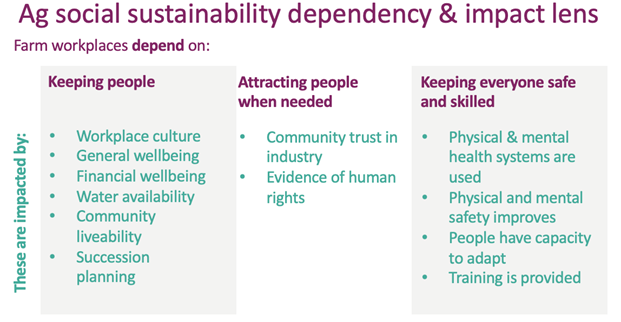
The Cotton Research and Development Corporation (CRDC)has worked for years with farm workplace experts and other ag industries to solve this issue, using the dependency and impact lens TISFD released yesterday. Our findings show:
1. Farm workplaces have three core dependencies to be productive and profitable:
- Keeping people
- Attracting people when needed
- Keeping everyone safe and skilled.
2. Experts have helped us define what impacts those dependencies - see summary graphic below.
This farm workplace research puts the “so what” into agriculture social sustainability. And it lets us measure what matters in farm workplaces, so we can manage the human, social and intellectual capital farmers depend on.
This workplace research has been well received by other industries. The Australian cotton industry is advocating for this to be the basis for coordinated and collaborative data collection by governments and industries to avoid inconsistency, duplication, unnecessary cost, and survey fatigue.