
Why do you grow cover crops?
Cover crops are grown for various reasons, with varying outcomes and across a variety of climates.
They are grown to help weed and disease suppression, alleviate long-fallow syndrome, protect young cotton plants from sand blasting or adverse weather and to keep the moisture in and soil temperature down. However, we also know that cover crops need to be carefully considered as they can also promote disease, harbour pests, deplete soil moisture and tie-up nutrients.
A global panel recently acknowledged cover crops are a major spoke in a list of sustainability and ‘regenerative agriculture’ practices (see previous story), yet there are very few guidelines around cover cropping in Australia or globally.
To ensure Australian cotton growers have the ability to grow the right cover crops at the right time, CRDC is supporting University of Sydney (USYD) Postdoctoral Research Fellow Tom O’Donoghue to create regional guidelines for cover cropping that cover both benefits and risks.
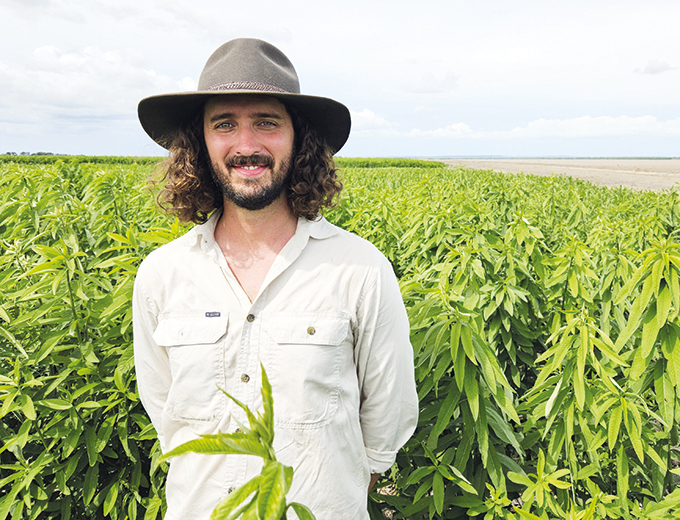
Firstly, Tom wants to know how and why growers are using cover crops.
“We want to know what services cover crops could or are offering crop managers in different valleys,” Tom said.
“From the answers, we will identify regional interests and experience and invite interested growers to participate in on-farm trials and guide the selection of ‘next step’ management practices for trials at USYD research farms near Narrabri and Spring Ridge (Kamilaroi country).
“A research program will then be built around quantifying performance in terms of emergence, yield, quality, disease, weeds, soil carbon, biodiversity, and water balance.
“We’ve already got some on-farm cover crop trials going at Emerald (Gayiri country) and through this farmer-led best practice we would like to establish regional guidelines for cover crops.”
Tom has been asking crop managers to answer basic questions and in return, all data collected will be passed back to growers raw, and following analysis he will provide performance evaluations of current cover cropping systems.
“It’s a great opportunity to have us look at your system and give feedback, while at the same time adding to our knowledge to produce reliable and relevant information about the benefits of cover cropping,” Tom said.
There’s already a lot of interest from growers at Emerald where he’s working with Qld DAF and CottonInfo’s Dr Paul Grundy on cover crop trials at Cowel Ag’s ‘Jabiwarra’ where Siberian millet, mungbean and Sunn hemp were planted and the effects compared to bare-earth plots. A field walk there in late February attracted a crowd keen to learn more about new cover crop options for the Central Highlands.
CRDC Acting Executive Director Allan Williams says Tom’s research goes further still to help bring Australia in line with global recommendations around cover cropping, which is to create regional knowledge.
Allan chairs the International Cotton Advisory Committee’s (ICAC) Expert Panel on the Social, Environmental and Economic Performance of cotton production (SEEP). In its report, Can Cotton Producers Adopt Regenerative Agriculture Practices?, SEEP says that to fully utilise cover crops “requires local research to evaluate optimum species and cultivars, species mixtures, planting methods/timing, agronomy, termination methods/timing and a local seed availability.”
“It’s about quantifying the risks and benefits of a particular cover crop in a particular region to ensure they are having a positive impact on-farm and also at an industry level,” Allan said.
For more
Tom O’Donoghue
This article appears courtesy of the Cotton Research and Development Corporation (CRDC). It was published in the (Autumn 2024) edition of CRDC’s Spotlight magazine: www.crdc.com.au/spotlight